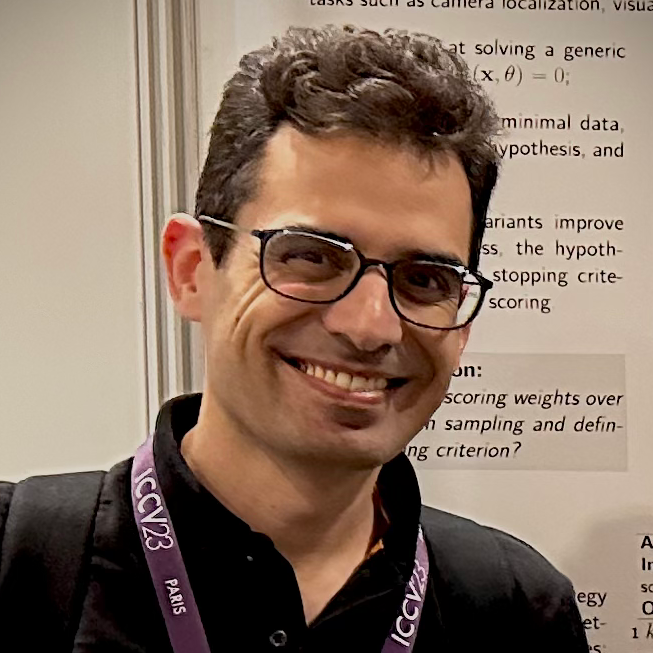
Pedro Miraldo is a Senior Principal Research Scientist at Mitsubishi Electric Research Laboratories (MERL), where he works on computer vision, robotics, artificial intelligence, and optimization, with a focus on 3D reconstruction, 3D representations, camera localization, and mapping for autonomous systems. Before joining MERL, he was a second-stage researcher, a position similar to Assistant Research Professor, in the Department of Electrical and Computer Engineering at Instituto Superior Técnico (IST), University of Lisbon. From 2018 to 2019, he was a postdoctoral associate at KTH Royal Institute of Technology. Previously, he held a national FCT postdoctoral grant at IST. He received his master’s and Ph.D. degrees in Electrical and Computer Engineering from the Faculty of Sciences and Technology, University of Coimbra, Portugal.
Talk Title: Revisiting Real-Time Visual Simultaneous Localization and Mapping
Abstract:
Visual Simultaneous Localization and Mapping (SLAM) is one of the most fundamental problems in computer vision, with direct applications to real-time localization tasks, including robotic localization and planning, AR/VR, and 3D scene reconstruction. In its most general and challenging form, it involves uncalibrated monocular RGB cameras, without IMU measurements, and camera localization in unknown environments. Significant progress has been made over the last two decades, though several challenges remain, including accurate camera localization, real-time operation, dense scene representation, and SLAM in dynamic scenes. In this talk, I will give a short overview of classical monocular visual SLAM approaches and discuss how more recent data-driven methods for feature extraction, image place recognition, and geometry estimation can contribute to SLAM in the uncalibrated monocular setting while preserving its real-time requirements. The talk will focus on the efficiency, accuracy, and robustness of pose estimation, as well as alternatives to pose graph optimization, which aims to continuously adjust the 3D map of the scene and ensure that the map remains consistent as new information is added.

