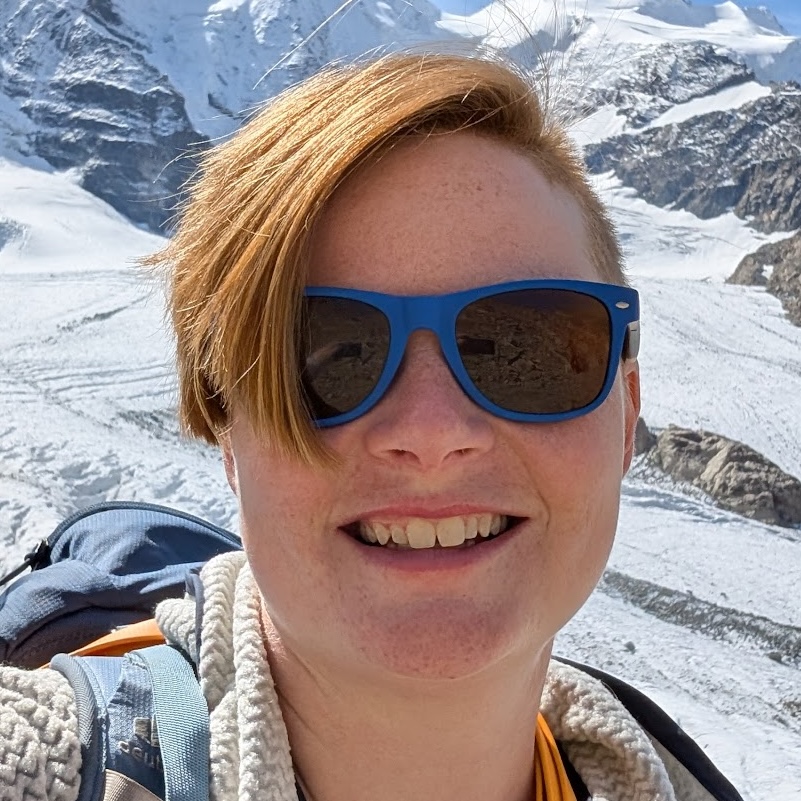
Helen Oleynikova has had a diverse career through academia and industry. She finished her bachelors in robotics in the US at Olin College of Engineering, then worked at Google on Street View for 2 years, and chose to return to robotics by doing a Masters, and then a PhD in Robotics at the Autonomous Systems Lab at ETH Zurich. Her PhD focused on safety and collision avoidance for drones: unifying fast, onlinevolumetric mapping with online replanning to best exploit the structure of the maps. Afterwards, she worked on the DARPA Subterranean challenge as a post-doc at the Autonomous Systems Lab. Returning to industry, she then worked as a Senior Scientist at the Microsoft Mixed Reality and AI Lab: investigating how we can use Mixed Reality to interact with robots, and what role mapping an co-localization can play in that. Afterwards, she joined the Nvidia Isaac 3D Perception team, working on rapidly GPU-accelerating volumetric mapping for a variety of robotics applications: from warehouse AMRs to mobile manipulators. She spent the last 2.5 years back in academica as a Senior Researcher at the Autonomous Systems Lab, supervising a large variety of topics between LiDAR-inertial odometry, robust state estimation, and mobile manipulation, and led EU project on infrastructure maintenance and inspection with both mobile manipulators and drones. Her most recent research interests focus on safety in online learning: how can residual learning and online reinforcement learning be used to compensate for unmodeled errors in the real-world? How can we combine classical priors with learned methods to increase sample efficiency? And finally, how can we make this safe and fast enough to run on robots in real-time? She also has some new career updates in store.
Talk Title: Across Academia, Industry, and Start-ups: A Roboticist’s Hard-Won Lessons
Abstract:
Having worked on just about every type of robotics platform (except underwater!) over the last 18 years, across academia, industry, and now most recently, in a start-up, I’ve learned a lot of lessons along the way. I’ll use this talk to share my journey through my rather non-linear career, and give some perspectives on my past research, where robots actually make sense to deploy in the world today, and what I think it will take to create the useful robots of the future.
On the research side, we’ll discuss how robots perceive their environment and how we can make useful representations that can be turned into robot action. On the career side, I’ll share my experiences from having just about every possible robotics job by this point, and share some lessons I had to learn the hard way.

